Showing posts with label ideas. Show all posts

Tuesday, March 25, 2014

WRITING WELLS: WRITING IDEAS FOR WHEN THE WELL IS DRY


Today is Monday.
It is time to write.
I don't have any ideas.
Nothing.
Nothing from the news
or the current events of my own life.
Nothing from my present reading,
my imaginings,
or my wonderings.
No thoughts light
a spark just this moment.
No spark to turn words
into liquid magic
which will flow
from my fingertips onto the keys
or from my pen onto the blank page.

So...I do what I sometimes do... and just begin to write....

What can we do when our word well runs dry ?
What can we do to restart the flow of words and images and ideas?

Just Write 
Sometimes just starting to write will spark more words and thoughts and writing. By just rambling on the page for a paragraph or two, you may find your momentum, your focus, and your flow.

It is important to get your fingers and mind moving even if  you write over and over... I don't know what to write... I don't know what to write.  This was a favorite tip offered to my student writers, and it invariably led them to topics at which they may not have arrived in a conventional manner.
They found words they didn't know they owned.

Try it when your well runs dry.

First Lines
Sometimes starting with someone's else's words is just what we need to get our own words flowing.

Write that first line of a favorite poem or short story or novel.  Start there and let your mind turn this phrase over and over, noticing different nuances or illuminating new facets. Meditate and write. Contemplate and compose.

Or write that puzzling sentence-- the one that you read over and over. Write about and through that sentence, teasing out new meanings, deeper significances, or personal prophecies.

In addition to your own selected favorite first lines, for sources of other potential lines for this purpose, see my previous post, First Lines.


Wild and Wonderful Lines
Sometimes we read a line so delicious and savory -- the sound of it,  the feel of it, the afterclap that hangs in the air of it. These are the words after which there is silence.. we don't want to break their spell or end the magic.  These are words that surprise us in the middle of passage and make us gasp aloud.  These are the words that come to us again, that we remember at odd moments-- How we wish we had written these words.  Ralph Fletcher calls these golden sentences. Vicki Spandel calls the active practice of looking for beautiful words sentence stalking.

These magnificent sentences can be used as first lines for our own writing... or food for thought for an exploratory essay, an experimental poem-- or a brand new structure.

Several of my favorite wild and wonderful lines include:

The process of learning is a nonstop orgy of wonderment. (The Magicians: A Novel  by Lev Grossman) 
Wild women don't worry. Wild Women don't get the blues.  (Ida Cox, uncrowned queen of the blues- song lyrics, 1929)
What would happen if one woman  told the truth about her life? The world would split open. (Muriel Rukeyser, poem, Kathe Kollwitz, in The Speed of Darkness,  1968)
I think it pisses God off if you walk by the color purple in a field somewhere and don't notice it. (The Color Purple by Alice Walker)


Analyze, Borrow, and Imitate

Sometimes it is not merely  words that get us going, but a structure or format of  a piece of writing.  What did the writer do?  What do I notice?  Can I name it ?  Can I do it too?
Mentor texts or texts that teach us how to write what we want to write, or give us a framework for our loose and unruly thoughts, are particularly helpful when we are stuck--when our word wells runs dry.

 I have recently discovered the work and words of Yehuda Amichai, hailed as Israel's finest poet.  I find myself wanting to underline every line, highlight every word in his lyrical, mystical poems.  And I have found several structures I want to try.
Dry days are days I experiment.

For example, in his poem As for the World, he begins each stanza with As for ....
As for the world....
As for my life...
As for the scream...
As for the deeds...
And in the last stanza, he repeats  this structure several times.
As for the palm of your hand,
as for the signals of my heart...
As for the writing on the wall...

This structure and several other structures he has used are on my list to analyze further, to borrow, to imitate.

For more on the value and use of mentor texts see the previous post, Mentor Texts: Learning to Write from What We Read


Nested Meditations

And finally, when I have no words to copy, or  analyze, or borrow.    I begin to meditate with a small phrase or a few words and let them lead me where they will.
.
The nested meditation is a simple, yet complex, cumulative, and layered  poetic structure created by Kevin Anderson.  It is my favorite tool when I am thinking about an idea, but don't know what to write, when I am sensing an idea on the tip of my mind, when I need to write, but my brain is not cooperating or forthcoming.

This is when I turn to the nested meditation.
The results always surprise.
Today's Nested Meditation
I don't know what to write. 
 I don't know what to write
and time is running out.
I don't know what to write
and time is running out
for yesterday's ideas.
I don't know what to write
and time is running out
for yesterday's ideas;
they are rotting as we speak.
I don't know what to write
and time is running out
on yesterday's ideas;
they are rotting as we speak
and tainting today's words.
I don't know what to write
and time is running out
on yesterday's idea;
they are rotting as we speak
and tainting today's words
as I search for a fresher yeast. 


For more on Nested Meditations and other writing ideas  for when you are stuck, see the previous and related post, Writer on the Block.

 See also The Writer's Notebook- Part 2 ( Resources) for additional ideas.


Today's Deeper Writing Possibilities

Select a favorite first line, or puzzling sentence, or wild and wonderful phrase from a text you are reading or have previously read.

Use this line or sentence to begin your own new piece of writing.

Let your writing flow-- following where ever you are led by the words you have chosen.

Borrow a structure from a text you are reading.  Can you compose a new texs using this structure?

Try a nested meditation beginning with one small sentence.

Monday, April 29, 2013

REWRITING TEXTS


Revision is writing.

A lot of writing is actually rewriting.

Developing ideas and writing them down, writing persistently, maintaining writing stamina. These are all important.

But rereading, re-seeing, re-visioning-- revising what we have initially written is a core part of writing and equally as important.

And what do we revise?

I am not talking about just correcting spelling or adding capital letters or sticking in commas that have been omitted. These are all surface level changes and are accomplished as we edit our writing.

Writing is about making choices as we put words down on paper or type onto our screens. 
Revision and rewriting is about carefully examining those choices and the effect they have in our total composition.

Revision involves looking at our writing again, and making changes that improve the writing--changes in meaning or content, structure or style, word choice or tone, and so forth.

Revision means making deep changes in how the writing will be read by others, how it will be deconstructed and then reconstructed by our readers, how it will affect others, .

As we write we are asking ourselves among other things:
Am I saying what I intend to say? 
Am I saying it clearly?
Am I saying if effectively, as well as beautifully?
Am I including all of the information that my reader will need?
In other words, we ask writer's questions. We are attempting to communicate our ideas and feelings and beliefs, and share information. How well dare we doing this?

As we re-consider or reread our writing, we ask a different set of questions-- reader's questions:
Does it mean what I intend it to mean? 
Does this sound the way I want it to sound?
Does it look the way I want it look?

Georgia Heard in the Revision Toolbox:: Teaching Techniques that Work, puts it this way:
Ultimately, the point of learning about revision is to learn how to help our writing match more accurately what's in our hearts. ( p.x)

Rewriting may mean that we need to enter or exit our piece in a different way--rewriting our lead or our closing. 

Rewriting may mean that sections, paragraphs, sentences, or words need to be rearranged--so we cut and paste (either literally or digitally.)

It may mean that a word is replaced with a more accurate, descriptive or specific word.

Revisions may occur in the way we tell our story--whose voice? which perpspective? whose point of view?  Whose story are we  telling?  From which angle? 

On his website, Ralph Fletcher offers young writers ideas about writing, including ideas for revising.  Click here to read his tips.

Every aspect of expressing your thoughts may be reconsidered, revised, rewritten.
Each writer has particular ways of  accompishing this crucial part of writing.

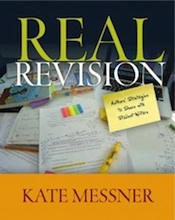
Kate Messner gives us a glimpse into effective strategies that professional writers use in Real Revision: Author's Strategies to Share with Student Writers. For each revision strategy she introduces, she also introduces us to several mentor authors who share their expertise, personal strategies, and helpful hints. 

Once of the most important statements she makes in her first chapter is Revision is hard.

I can attest to this fact.  Having finished drafting my book, the real work--the hard work--began in the revision process.  In a box in my basement there must be at least 7 iterations of the entire book, as well as many versions of specific sections.  Some versions I still revisit and use.  They contain sections, elements or information  that was removed in later versions, but that occasionally I need to use in the original, although deleted or revised state.

Messner says:
Revision is where stories start to sing. Where lumpy writing gets smoothed out and where good writing turn into great writing.  It's the part where the real magic happens.

So how do we revise?
How do we decide which ideas stay and which need to go?
How do we think about our writing and reconcile
what we intended to say
with what is actually on the paper or the screen?
How do we re-see, re-envision, revise what we have written?
What will make our words pop and jump – rising from the page
to reach our readers at their core?
How do we revise?


Revision is hard.

But revision is necessary.

Revision is writing.


Today's Deeper Writing Possibilities

Select a draft or unfinished piece of writing.

Reflect on the purposes and intent of this writing. 

What effect do you want this writing to have on your readers?

Consider this writing in light of some of the questions and revision issues raised above.

How do you re-envision this piece to most effective, accurately, clearly communicate your ideas and intentions?

Rewrite your piece making changes that will transform your good writing into extraordinary writing.


Wednesday, March 20, 2013

WRITERS ON THE BLOCK


Writers block.

Writers block 
the truth they know.                                 

Writers block
the truth they know
in their first mind.

Writers block
the truth they know
in their first mind
(instead of) giving full rein.

Writers block
the truth they know
in their first mind
giving full rein
to their second and third minds.

Writers block
the truth they know 
in their first mind
giving full rein
to their second and third minds
ignoring the words.


Writers block
the truth they know 
in their first mind
giving full rein
to their second and third minds
ignoring the words
eager to be born.


Writers block

That's what we call it when we can't get started, when we don't have any ideas, when we just don't have anything to write about--nothing to say.

Nothing has happened.

Or everything has happened --and it is just too much to sort out and organize-- and you don't know how you feel.

Reading  stories of other writers may help.

Reading about the ways they gather ideas,  notice the ordinary, remember the extraordinary, pay homage to their musings, and  noodle around with words may be just enough to nudge us off the block that we writers sit on when our second minds tell us that what we thought in the first place is no good.


Reading about how Langston Hughes,  while riding a train, was struck by the many rivers that have run through his ancestors veins, flowed through his people may help----  the result was his poem The Negro Speaks of Rivers.  Robert Burleigh tells this story in Langston's Train Ride.


William Carlos Williams may get us down off the block-- he writes about everyday ordinary things around him in a loose conversational style, that we may find easy to imitate, and then make our own.  


He is able to look at life and see beyond the present object to deeper insights and truths. He tells  his stories through small short musings. Two of his  well known poems include, The Red Wheelbarrow and This is Just to Say.  His story is told by Jen Bryant in  A River of Words: The Story of William Carlos Williams.


In Nothing Ever Happens on 90th Street, Eve sits on her stoop, (or rather on the writer's block) unable to think of ideas for a school writing assignment in which her teacher had simply said Write what you know. From the various characters that live  in her neighborhood, she receives advice that will draw us all down from our writer's block. 
The actor: The whole world is a stage-watch the stage, observe the players, and don't neglect the details. 
The cook: There's always a new way with words- find the poetry in your pudding

The dancer:  Stretch your imagination-stretch the truth. Ask What If?
Another neighbor:  It's like making soup- add a little action, a little spice
When I read this book one year to my fifth graders,  we made a chart of writing suggestions we found in this book .  The chart remained on our wall all year.   They referred to it often when they were stuck.

So sometimes getting unstuck or coming down from the  writer's block is as simple as looking at the writing, the objects around you, your ideas, or the assignments from a different angle, turning them over to see the underside, the hidden part, or noticing the obvious parts that you may have deemed unimportant.

One of the ways I meander around ideas is using the nested meditation form that opened this post. I love the structure of this short form  created by Kevin Anderson.    

The rules are few and simple (and flexible):


Begin with a single line that forms a complete sentence. 
Each stanza must be a complete sentence.  
Each stanza must include the lines from the previous stanza (punctuation and capitalization may be adjusted as necessary for each stanza to make sense) and each stanza be able to must stand alone.

For a more extensive explanation and for samples of nested meditations see Anderson's book,Divinity in Disguise: Nested Meditations to Delight the Mind and Awaken the Soul and his website.

 While on a CAWP retreat at Kenyon College, a couple of years ago,
I wrote another poem about being stuck.  Click here to read the poem, Staring at the Blank Page.

What do you do when you are stuck in your writing?

How do you climb down off the writer's block?


 Today's Deeper Writing Possibilities

Consider a piece of writing on which you have been stuck, or an idea you have been unsuccessful in writing.

Select or create one line with which to begin a nested meditation. Where did that writing lead you ?  What did you discover?

Try one of the ideas suggested by Eva' s neighbors to work on a piece on which you are stuck.