Showing posts with label Revision. Show all posts

Wednesday, January 22, 2014

EXPLODING A MOMENT: EXPLORING WITH WRITING


I sat on a bench outside the retreat center.
It was the summer of 2005.
I was early--excited-anticipating-and-ready early.
Today I was beginning what would become my continuing relationship with the Columbus Area Writing Project and the National Writing Project.

I was waiting for the Columbus Area Writing Project 2005 Summer Institute to begin.

While I waited, I was reading ( Isn't this what we all do as we wait--if we are not writing?).

As I looked up from my book for a moment to enjoy my surroundings, the event in the following poem occurred.  A man appeared out of nowhere and offered me water.  I wrote the poem on the inside flap of my book.

The Water Man

Sitting on a bench
under a tree
in front of the retreat center
in the cool breeze
waiting
reading a book
beginning to notice my thirst

A man walking
appeared and asked
Are you ready for a drink
of water?
He had two.
He gave me one.

Later I saw him
laying stones
for a new path.

Sometimes a moment strikes us as noteworthy and write-worthy.  

Sometimes we just have to capture that moment-- to later turn it over in our minds, to insert it into the unfinished story we are writing or to use it to transform the piece of poem that has floated near our ear for days.

We grab a napkin, a scrap of paper, or the inside flap of the book we are reading and jot down notes or a whole poem.

On further reflection of this moment, upon deeper consideration and rereading, the moment can be expanded and details can be added:

What additional details do you now remember?
What sensory details can be added? Where can further description be expanded?
What comparisons occur to you?
Can you add analogies? Are there appropriate metaphors that can be included?
What did it mean?  How did you feel? 

In the summer institute one of the many prompts we were given was to "slow down time by exploding the moment."  My response to this prompt was to revisit and revise The Waterman.  It was interesting to realize that there was much more to remember, to visualize, to consider in this moment.

The result is this second poem.


The Water Man 2
( Exploding the Moment)

Sitting on a bench
under a tree
in front of
the Maria Stein retreat center
in the cool breeze
with the flag flapping
waiting--
reading a book
observing the quiet
and the stillness--
noticing
the bridge
and the pond
 and the island--
watching for the others to come
content

to wait--
beginning to notice my thirst

A man walking
appeared
 and asked
Are you ready for nice cold drink
of water?
He had two.
Frosted, they dripped
with condensation
and satisfaction.

He smiled and
gave me one.

Later I saw him
along with a young man
a teenager
(his son?)
laying stones
for a new path


Even as I reread this now I remember more about that moment-- off to my right close to the road sat the church that held the relics and off to my far left I could see the stone labyrinth.  No one was walking it in prayer during my moment.

I keep thinking.
I keep remembering more.
What moment sticks with you?
What moment could you explore and explode?

In Chapter 5 of After "The End": Teaching and Learning Creative Revision, Barry Lane suggests many way  to slowing down time in our writing, many strategies that can be used as we write drafts and during the revision process. He also provides excellent examples  of pieces in which moments have been explored and exploded.

For step-by-step directions for one way revise expand, explore and explode your moments click here.

For additional sample pieces illustrating this strategy click here.

And finally in the following video,  Barry Lane explodes a moment with us:


What moment sticks in you mind?
Which moment can you explore, expand, and explode?

Today's Deeper Writing Possibilities

Reflect on a recent moment in your life or in a fictional piece you are writing-- a noteworthy, write-worthy moment.
Picture that moment in slow motion.
Begin to record more and more details  of that "slowed-down" time.

What do you see? hear? smell? touch? taste?
Have you been in a moment like this before?
What are you thinking?
How do you feel?
What does it mean?

You may want to write your slowed down impressions as a poem or narrative.

Monday, April 29, 2013

REWRITING TEXTS


Revision is writing.

A lot of writing is actually rewriting.

Developing ideas and writing them down, writing persistently, maintaining writing stamina. These are all important.

But rereading, re-seeing, re-visioning-- revising what we have initially written is a core part of writing and equally as important.

And what do we revise?

I am not talking about just correcting spelling or adding capital letters or sticking in commas that have been omitted. These are all surface level changes and are accomplished as we edit our writing.

Writing is about making choices as we put words down on paper or type onto our screens. 
Revision and rewriting is about carefully examining those choices and the effect they have in our total composition.

Revision involves looking at our writing again, and making changes that improve the writing--changes in meaning or content, structure or style, word choice or tone, and so forth.

Revision means making deep changes in how the writing will be read by others, how it will be deconstructed and then reconstructed by our readers, how it will affect others, .

As we write we are asking ourselves among other things:
Am I saying what I intend to say? 
Am I saying it clearly?
Am I saying if effectively, as well as beautifully?
Am I including all of the information that my reader will need?
In other words, we ask writer's questions. We are attempting to communicate our ideas and feelings and beliefs, and share information. How well dare we doing this?

As we re-consider or reread our writing, we ask a different set of questions-- reader's questions:
Does it mean what I intend it to mean? 
Does this sound the way I want it to sound?
Does it look the way I want it look?

Georgia Heard in the Revision Toolbox:: Teaching Techniques that Work, puts it this way:
Ultimately, the point of learning about revision is to learn how to help our writing match more accurately what's in our hearts. ( p.x)

Rewriting may mean that we need to enter or exit our piece in a different way--rewriting our lead or our closing. 

Rewriting may mean that sections, paragraphs, sentences, or words need to be rearranged--so we cut and paste (either literally or digitally.)

It may mean that a word is replaced with a more accurate, descriptive or specific word.

Revisions may occur in the way we tell our story--whose voice? which perpspective? whose point of view?  Whose story are we  telling?  From which angle? 

On his website, Ralph Fletcher offers young writers ideas about writing, including ideas for revising.  Click here to read his tips.

Every aspect of expressing your thoughts may be reconsidered, revised, rewritten.
Each writer has particular ways of  accompishing this crucial part of writing.

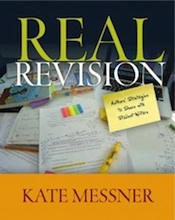
Kate Messner gives us a glimpse into effective strategies that professional writers use in Real Revision: Author's Strategies to Share with Student Writers. For each revision strategy she introduces, she also introduces us to several mentor authors who share their expertise, personal strategies, and helpful hints. 

Once of the most important statements she makes in her first chapter is Revision is hard.

I can attest to this fact.  Having finished drafting my book, the real work--the hard work--began in the revision process.  In a box in my basement there must be at least 7 iterations of the entire book, as well as many versions of specific sections.  Some versions I still revisit and use.  They contain sections, elements or information  that was removed in later versions, but that occasionally I need to use in the original, although deleted or revised state.

Messner says:
Revision is where stories start to sing. Where lumpy writing gets smoothed out and where good writing turn into great writing.  It's the part where the real magic happens.

So how do we revise?
How do we decide which ideas stay and which need to go?
How do we think about our writing and reconcile
what we intended to say
with what is actually on the paper or the screen?
How do we re-see, re-envision, revise what we have written?
What will make our words pop and jump – rising from the page
to reach our readers at their core?
How do we revise?


Revision is hard.

But revision is necessary.

Revision is writing.


Today's Deeper Writing Possibilities

Select a draft or unfinished piece of writing.

Reflect on the purposes and intent of this writing. 

What effect do you want this writing to have on your readers?

Consider this writing in light of some of the questions and revision issues raised above.

How do you re-envision this piece to most effective, accurately, clearly communicate your ideas and intentions?

Rewrite your piece making changes that will transform your good writing into extraordinary writing.