Showing posts with label Trayvon Martin. Show all posts

Friday, November 8, 2013

THE DISCOURSE OF IMAGES

What do we see when we look at images?
How do images speak to us?

How do images speak to other images?

Discourse studies, with its roots in classic rhetoric, has traditionally been about speaking well, and thinking and talking about texts.  Now, however, this area of study also includes multi-modal, multi-disciplinary, and contextual considerations--and images.


According to Teun A. Van Duk in the introduction of Discourse Studies: A Multidisciplinary Introduction
Discourse is no longer just conceived of as verbal text and talk, but also encompasses the nature of context…(xvii)    
Contemporary discourse studies now also involve many disciplines-- anthropology, sociology, linguistics, psychology—all areas of the humanities.  According to Van Duk: 
Research into discourse today... combines the study of language use, verbal interaction, conversation, texts, multi-modal messages, and communicative events (2)  
As we think about text and talk there are several fundamental properties we must consider.  Van Duk asks us to think about discourse, variously as:   

  • Social interaction
  • Power and domination
  • Communication
  • Contextually situated
  • Social semiosis
  • Complex layered construct
  • Sequences and hierarchies
  • Abstract structures vs. dynamic strategies
  • Types of genres
So as we interact with, question, and analyze texts, we might examine each of these properties within the text and in relation to other texts.

There are many forms of writing that embody the talk in which we engage with others, our talk about texts, and also the talk we have around images.  As we interact more frequently and critically with both texts and images, we find that texts can “talk” to other texts.  See related post, Strange Bedfellows: Texts Speak to Texts.
As we transition into thinking about images and how we respond to such, an excellent resource is Twice Told: Original Stories Inspired by Original Artwork by Scott Hunt.  In this collection of YA fictional stories, pairs of well-known writers each write  in response to a single image, which allows us to recognize that images speak to us in individual and differentiated ways.  I have successfully used the paired stories by Jaime Adoff and Margaret Haddix Peterson to initiate conversations about how we see images.

Likewise, images can “talk” to images---supporting, complementing, supplementing, augmenting, illuminating, diminishing,  pushing, or opposing each other.  

And I suggest that the fundamental properties of discourse listed above also can be applied to images. We can ask the same questions of images that we might ask of  texts or other discourses.  
How is the image contextually situated? What sequences and hierarchies are represented? Absent? 

One example of an image talking through another image is The Periodic Table of Poetic Elements by Jeffrey Skinner He has humorously represented poetic and literary elements  in the format of the traditional scientific Periodic Table.. (Skinner's Periodic Table is also available in in The 6.5 Practices of Moderately Successful Poets: A Self-Help Memoir 
What conversations does this unique poem initiate? What questions does it force us to ask?

What do we see and hear as we talk with images?  
What do we see and hear as we allow the images to talk to each other?

Juxtaposed images can create tension and demand we enter their conversation
An article by Tom Roston, On Pinterest and in Documentaries, Don’t Judge a Killer By An Image,  provides two pairs of images that will generate conversation around the topic George Zimmerman and Trayvon Martin. These images present negative and positive images of both Zimmerman and Martin.  This alone fosters discourse around these images.  

However,  the article discloses that the negative image of Trayvon Martin is falsified--- it is not really him, but had been posted on Pinterest by a white supremacist Several news sources confirmed the lie.  What further conversations are generated as a result of that new knowledge? 

This article itself becomes a mentor text of discourse around images and, depending on the age of your writers, you may want to share it with them after discussion of the images. 
In addition to your observations related to the chosen images, you may also want to use Van Duk's discourse properties listed above to further analyze and question the images.

On a related note, I gasped out loud when I saw the first iconic picture of Trayvon Martin in the red shirt.  He so eerily favored Emmett Till, a fourteen-year old boy who was murdered/lynched  in Mississippi in 1955 for supposedly whistling as a white woman.

Images don’t necessarily have to be controversial to create tension. Critical thinking and conversation may result from the juxtaposition, context, symbolism, surprising elements, or some other  focus in the image or set of images.
Joel Robinson’s images depicting the joy of reading can also talk to us and each other. These are available on one of my favorite blogs, Brain Pickings by Maria Popova and will also foster critical discourse.

Today's Deeper Writing Possibilities

Take your  own photographs or  locate in magazines or other sources, including the Internet, two or more images that in some way “talk” to each other.
The images may complement, supplement, augment, diminish, or oppose each other.

Write a reflective response or essay to these images, describing and representing the relationships to each other and perhaps also to yourself. 

Write a poem capturing the conversation you had with the images-- or the conversation you imagine between the images.

Monday, July 22, 2013

WHO ARE WE IN AMERICA?

Our president, Barack Obama, spoke to the press on July 19, 2013.
Click here to see a video and read the transcript of his remarks at this press conference.
.
He spoke about a topic on which many of us had been waiting, wanting, and expecting him to address--
the Trayvon Martin ruling.

He, along with most of us, is asking Who are we in America?

He, along with most us, is asking Where do we go from here?

And he, along with most of us,  is searching his heart and soul, his knowledge, authority and power, his expectations, affordances, and hindrances  to discover exactly who we are.

Educator and professional author Christopher Lehman, among others, engages in this soul-searching and wrestles with this topic in his recent blog post, On This Next Day.

In this nation-- in America-- we are created by words and documents.  Those historical and living words say who we are here in this country.  In my book, Deeper Writing: Quick Writes and Mentor Texts to Illuminate New Possibilities,  I address our founding documents and those living words that guide us in this way:

...documents outline our collective rights and rules, our national principles and  purposes, and our highest hopes and dreams.  Throughout our history as a nation, we have also repeatedly been defined and redefined by the words of strong and courageous men and women--words on paper preserved for posterity, and words spoken aloud to audiences--small and intimate or multitudes.
Words have led us to consider ourselves and how we interact with each other, both at home and abroad .... Words have sometimes spurred us to greatness, at other times shamed us into making sweeping changes, and often challenged the best part of our humanity to create a nation that continues to grow and create new possibilities.

In troubling times, in times of confusion and disappointment, like we face now-- in times when our nation is questioning itself-- we return to these documents for direction, solace and restoration.

We have faced many such times.
Who are we in these times?
Who are we in America?

As we engage in the soul searching and reflection that our president calls all of us to do, we may want to return to these documents, literally, to remind ourselves from whence we have come and to support us as we determine individually and collectively where we are going.

Most important founding and governing documents of our nation, including the Declaration of Independence, the Constitution of the United States, the Bill of Rights, the Amendments to the Constitution and the Federalist Papers  can be found here, at Founding Fathers.Info.

Along with these essential documents, wise words of many of our fathers and mothers, our fellow citizens and others have also guided our nation and helped us to discover, remember, and become who we are.

Following September 11, 2001, Walter Dean Myers asked himself  the same question we are all asking now, and felt impelled to reread all of those  founding and governing documents I listed above--those that he felt " formed the core ideas of what America is about..."

Myers explored his findings in a mix  of poetry and quotes from people in our history --famous or not so famous-- along with quotes from our founding documents. The result was We Are America: A Tribute from the Heart. Those wanting more details and references will find that in the back matter, along with notes on the art created for this book by his son, Christopher Myers.
.
Who are we in America?

Sometimes being an American means speaking the truth.  Sometimes being an American means saying what our fellow Americans may not want to hear or recognize.

Who are we in America?
And what is our Truth.

We are Abraham Lincoln, John F. Kennedy, Martin Luther King and Malcolm X.  We are Sojourner Truth, Susan B.Anthony, and Michelle Obama---all standing up, speaking out, telling us who we need to be.

Robert Shetterly, like Walter Dean Myers, also felt compelled to reflect upon and discover who we are as Americans.  He used art to explore those qualities, painting 50 portraits of Americans who for him represented the best part of Americans.  He selected those who words were Truth we all needed to hear.
The result was Americans Who Tell the Truth.

Who are the Americans who are today speaking Truth to power?

Who are we in America?


As President Obama has called us to reflect, to search our souls and to reflect on who we are, he ended his remarks with the following words:

And so we have to be vigilant and we have to work on these issues. And those of us in authority should be doing everything we can to encourage the better angels of our nature, as opposed to using these episodes to heighten divisions. But we should also have confidence that kids these days, I think, have more sense than we did back then, and certainly more than our parents did or our grandparents did; and that along this long, difficult journey, we’re becoming a more perfect union — not a perfect union, but a more perfect union. - See a video and the transcript of his complete remarks here.


Today's Deeper Writing Possibilities


Write an essay or letter responding to his remarks expressing your feelings, ideas--your Truth.

Write a letter to the jury agreeing, disagreeing, or questioning their ruling.


Read The Poetic States of America by John Laue (Rattle #38 Winter 2012) and my poem Who Are We In America?

Write your own  poem or essay which wrestling with the question Who are we in America?


Monday, July 8, 2013

TRIALS OF OUR NATION

 I am watching the trial.

The George Zimmerman trial.

I am caught up in the drama, the emotion, and even the entertainment aspect of this trial.

HLN (Headline News, an CNN afficliate) is running the trial in its entirety-including the segments  for which the jury is removed from the court.  We not only see the onstage performance, but the behind the scenes battles and maneuvers, as well.

This is being played out on the national stage.

And the audience- glued to the action in the courtroom-- watches from the sidelines, full of advise, opinions, hopes and fears.

We watch almost like this is a sports events --cheering on the side of our choice.

Each side recontructs that fateful night--the night Trayvon Martin died.
Each side presents witnesses who swear to tell the truth to the best of their ability...so help them God.

Each witness has their truth neatly unfolded like a quilt and laid out before everyone.  
Then lawyers slowly pick at the threads in an effort to tear up this particular quilt of truth and lay the shreds before the jury-- to the benefit of whichever side they represent.

Each side seeks truth-- or rather each side presents its own truth with the hope that it becomes the truth the jury sees.

This trial will take its place on the list of others that have captured our nation's undivided attention.
This trial and its results will be counted among those that initiate new conversations--conversations about race and laws and freedom and America.
This trial will ultimately rank among those that transform our nation.

There have been other trials, with which we still remain fascinated--others that opened important conversations and changed who we are as a nation.  Among them are:


  • The Salem Witch Trials
  • The  Dred Scott Case
  • The Scopes Trial
  • The Trial of Jack Ruby
  • Roe V. Wade
  • The O.J. Simpson Trial
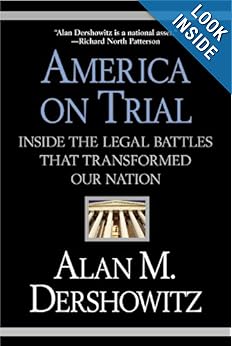
America on Trial: Inside Legal Battles that Transformed Our Nation by Alan M. Dershowitz allows us to look behind the scenes and the headlines to closely examine 60 of the most important and intriguing of these transformative trials. 

He goes back some 300 years to colonial days to the Salem Witch Trials and brings us forward again to more recent and current  trials like The Clinton Impeachment Trial, to examine how these legal battles shaped our nation and its citizens.


And  we all remember reading the great trial books in high school.
Those classics recounted narratives based on real cases, as well as those fictional ones that imitated the best or worst of our public behavior and legal legacy.


How did these trial books become the classics that we feel all American students should read? 
Perhaps because they reveal our character, our flaws and brokenness, our greatest fears and tightest held hopes ---and our ability to rise above the worst among us to build and rebuild our nation and our American character repeatedly--individually and collectively.


As I researched the trial, I came across this publication by national commentator, columnist, and radio host, Earl Ofari Hutchinson.  In America on Trial: The Slaying of Trayvon Martin, released on the eve of the George Zimmerman trial,  he lays out background information that may serve as a watching companion.

It is Hutchinson's thought that more is at stake than just the fate of George Zimmerman.
The Martin slaying was now firmly and indelibly embedded in America's public mind as not just a personal tragedy of a young life needlessly lost, and  the tragedy of a man who thought he was doing his duty to protect his community.  It is now a tragedy that ignited a national soul search. The Martin slaying now put race, the justice system, and indeed, public perception and attitudes toward both squarely on trial.
 For more of his view see His Blog The Hutchinson Political Report or webpage, The Hutchinson Report News


As the trial marches forward to its conclusion, we hold our breath.
Who wins and who loses?

Trayvon is the biggest loser--he lost his life.

He can't appear in the court room to tell his story.
He has to depend on the evidence--concrete and circumstantial-- witnesses and lawyers, to tell his story from the grave.

His family has lost-- lost him, their right to grieve in peace, and their privacy.

George Zimmerman has lost, as well.
He has caused his family much grief, as they defend his actions.

Both mothers claim their son is the one screaming and crying for help on the now infamous 911 tape from the scene that night.

We have all lost.
A child  who was walking to his own house from the store, carrying an Arizona Tea and a box of Skittles--a child who looks like my step-sons-- is dead

According to Sam Stein of the Huffington Post President  Obama responded following this event:

If I had a son, he'd look like Trayvon.

That this tragedy could happen in our country speaks volumes about our country and who we are.

Stein reports that Obama went on to say:

Obviously, this is a tragedy... I think every parent in America should be able to understand why it is absolutely imperative that we investigate every aspect of this, and that everybody pulls together -- federal, state and local -- to figure out exactly how this tragedy happened...I think all of us have to do some soul searching to figure out how does something like this happen.  And that means we examine the laws and the context for what happened, as well as the specifics of the incident.

The  jury's decision will change our country and inform that conversations we will have in the future.

Who will the jury believe?

Who do you believe?


Today's Deeper Writing Possibilities


As you watch the trial, think about the evidence being presented from different perspectives.

How is Trayvon's mother hearing what is being presented?
How is George's mother hearing what is being presented?

What are members of the Black, White and Latino communities thinking about the trial so far?

What is the goal of the defense?
What is the goal of the prosecution?

What are your predicitions about the outcomes of the George Zimmerman trial?
How will this outcome affect our nation?

Write an argumentative essay about the guilt or innocence of George Zimmerman.  Support your arguments with evidence from the trial presentedbefore the jury.


Monday, February 4, 2013

A SEASON OF GUNS


Guns.

Violence.

Mass shootings.

Death.

Deaths of children.

And children … and children.


 I ease up warily to the news  these days.  Will there be another shooting today?   Did some young man decide today is the day to avenge, to  erupt, to disappear from earth, to make a name, to claim his 15 minutes of fame?

Who should have seen and known and reported or aided or medicated? Who should have noticed tears or lack of tears, or wild talk… or murderous silence?

We wonder… after…. could that be me or mine or them or theirs?  
Could I have been in the wrong place at the wrong time with the wrong people when he showed up to obliterate his pain by creating my pain/our pain?

The newspapers carry stories and interviews—we examine his childhood, school records, the parents, the neighbors, the papers he wrote, his Facebook page, the statement he reportedly made on the playground on Thursday, the time he would not answer the teacher in class…

or

there was no evidence, no trail, no inkling, no portent of the coming rain of bullets. We didn’t know.  We don’t believe…

The headlines we face daily lately and the news on the radio jumps out at us… and we moan… Oh No! Not again!

After Virginia Tech erupted in gunfire, after Columbine, after Trayvon Martin died going home from the store, after Batman invaded the Century Movie Theater in Aurora , after the Sikh Temple shootings, after Newtown ...

How do we talk about this?  What conversations do we need to begin?

Sometimes the only way to make sense of the realities in our world is to turn to fiction. Fiction can reveal the truths clothed in stories of imagination. Making Up Megaboy by Virginia Walter is one such fiction that leads us into conversations that help us examine our thoughts, perspectives, questions, and surprise at these events. I find that books always fall into my hands when they are needed and I discovered this one after the Virginia Tech shooting. Originally published in 1998, It could have been written this year, given its plot and theme. 


Robbie Jones, a middle-school student, takes his father’s gun and shoots an elderly Korean store owner.  This short young adult novel is a case study, an inquiry, that examines Robbie’s life through the lenses of those connected to him before and after the shooting-- teachers, parents, news journalists, best friend.  His life unfolds through their eyes allowing us to turn over the possibilities of his life and sort through the various pieces of evidence or lack thereof.

Through his story, we can begin conversations about the alienated, the mentally ill, the substance-filled, the youths, and others with ready access to guns.

We can begin to take a close look at our landscape which contains such violence.

We can also begin to ask: Who am I in these stories?


Today’s Deeper Writing Possibility
Have you or your family or friends been personally affected by a shooting?
What do you remember about the event?

Write about the events from your perspective.

Then try writing about the events through the eyes of others involved.