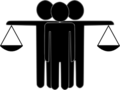
| Statue in Kelly Ingram Park, Birmingham, Alabama Photo by Robert Fincher |
Emmett Till
Trayvon Martin
And now...
Michael Brown
And all the boys
whose names we don't know.
All the maimed and broken men
whose voices have been silenced
mouths stuffed with their own manhood.
For all those who have died
for being who they are
from the minute the first African foot
stepped on this land
Black men driving,
walking
breathing
just being alive
and being black
are in danger
It has become open season
open season on black men.
It has again become okay
to execute black boys
in the street.
for running away from
their certain fate.
(shot in the back)
for walking,
for standing
with their heads up
with their hands up
(shot in the head)
in front of many witnesses
who are then told
to remain calm.
Watch black boys die
and remain calm.
The executioner
remains
alive
un-named*
free
We have seen it before
heard it in the past
Deja Vu
***
Only black families teach their sons specifically what to do when stopped by the police.
No sudden movements. Hands in plain sight-- on the steering wheel or raised in the air.. Don't reach for the glove compartment, your pocket, the floor. Be polite. Yes, Sir. Even tone. No raised voice. Call us as soon as you get your phone call.You get the picture.
That conversation does not take place at white dinner tables.
Only black mothers wait in the store instead of the car as their teen or preteen sons Christmas shop, in case there is an incident --in case their sons begin to " look suspicious."
In my family (and most black families I know)--- every black male--- from my young nephew to my now deceased 87-year father-- has been stopped for driving while black
because he "looked like someone else"
because he "couldn't possibly legitimately be in that BMW or Escalade or Infiniti"
and even though no traffic light was run, no stop sign ignored, no speed limit exceeded, nor any other law infracted--- "he must have done something".
Yes-- it is open season on black men.
That season never really ended.
Those that say we have arrived because the head face
in the White House
is brownhave not walked the streets lately
with a black boy or man.
It is open season on black males.
* The police officer's name, Darren Wilson, was released after this poem was written.
***
Several books may be helpful in the healing.
These and other such books may begin the necessary conversations, instill the pride and encouragement, and educate people, all people-- ourselves, as well as people in need of walking in shoes that are not their own.
 What If?: Short Stories to Spark Diversity Dialogue
 by Steve Long-Nyugen Robbins is written with the multi-ethnic work place in mind. However, the situations addressed are relevant to education and society in general. The inspirational stories are accompanied by questions and exercises focused on key learnings with practical suggestions for applications and actions.
Walking in each other's shoes is critical. Knowing each other's stories is essential. Generating solutions is crucial.
 Fire and Ink: An Anthology of Social Action Writing
 edited by France Payne Adler, Debra Busman, and Diana Garcia is the best collection of writing dealing with a multitude of issues, including authors simply telling about their lives and where they are from, raising their voices against the silence, and speaking out and/or about race, gender, class, language, labor and employment, prison, health and the environment, and war.
Included are poems, stories, interviews and essays
The last chapter includes writing about social action writing and ways to initiate such writing in the classroom and outside of the classroom.
This book is an essential addition to the library of each person wanting to make a difference through reading and writing. The writing in this book will open eyes and educate, begin conversations, and inspire your own writing.
Additional sources that present questions we might use to frame the needed conversations are presented in the following blog posts:
What Do We Teach When Children Are Dying by Chris Lehmann (Practical Theory: a View From the Schoolhouse.)
Helping Students Make Sense of a Young Man's Death in Missouri by Juana Summers ( NPR ED Blog: How Learning Happens)
For Young Black Men
 The Black Male Handbook: A Blueprint for Life
 by Kevin Powell is written for black men interested in
shaping and reshaping their lives in positive ways. The collected essays in this book address all aspects of life--spirituality, health, politics, violence, women and more.
In the same vein, are two books that also offer young black men inspiration, advice and encouragement as they journey toward manhood.


For Teachers
 The National Writing Project has recently released an important and timely report on, Teachers Voices: Teaching Young Men of Color , which includes thoughts on race, gender, role models, the role of school, and reform.
It also includes related assignments that may be appropriate for your students.
The National Writing Project also has shared Poetic Broadsides (Chapter 6 excerpted from Reading for their Life by Alfred W Tatum which suggest poetry as a way of engaging young black males-- poetry that uplifts, educates,
 acknowledges their varied realities and suggests solution

 As our classrooms become more diverse, Other People's Children: Cultural Conflict in the Classroom
 by Lisa Delpit remains a pivotal text which forces us to examine our own biases and
prejudices as we teach the children in front of us. The lessons learned transfer to all of our interactions in society.
Young folks of all colors must understand that there are powerful and courageous black men who have made a difference, who have changed the world, who stand as heroes and role models for us all. Andrea Pinkney has selected a representative ten of such men to present as positive images.
And the award winning book about Barack Obama's hope and dreams as a young boy have been inspiring to every child with whom I have shared it.


There are, of course, many books that could be listed here, many that would start conversations, begin healing---- and end the open season on black men.
There represent possible starting places.
Online Resources
In addition there are many online resources that can add in subtantive ways to these conversations. These websites inform and educate, remind and make us aware---they make us think critically and read our world critically.
These are few of my favorites. The resources below include a variety of articles, essays, photos and films, and other writings, as well as specific teaching materials and lesson plans, which can be used in and out of classrooms. All also offer magazines, journals and other publications.
Rethinking schools
Teaching Tolerance: A Project ot the Southern Poverty Law Center
Zinn Education Project- Teaching a People's History
My own previous post, Social Justice, may also provide you with food for thought, as well as helpful resources. At the end of the post is a list of additional related posts, all containing relevant texts and resources that may be useful at this time.
Social Justice-- Deeper Writing and ( Reading ) of the World
The healing must begin.
The conversations must occur.
The important thing is that we start-- now
Today's Deeper Writing Possibilities
Reflect on the recent news reports about the shooting of Michael Brown by police officers in Ferguson, Missouri. Think about all parties involved and consider the thoughts and actions of Michael, the police officers, journalists, bystanders and witnesses, the mother of the victim, his friend who was walking with him, and others.
Write a poem about this incident.
You may want to present your poem in one voice or you could include many voices.
Write an essay about how to end the rash of recent shootings of young black men by police officers.
Write a letter to the editor offering solutions to the mayor of Ferguson.