Showing posts with label summer institute. Show all posts

Wednesday, July 2, 2014

CAWP AND WRITING EVER AFTER


 Writing Ever After


The  Columbus Area Writing Project 2014 Summer Institute is over.

The daily dose of writing... and talk about writing... and teaching and learning and students and classrooms... and all manner of other things is over.

The guaranteed uninterrupted writing time and opportunity for immediate responses in writing group is over.

So what do we do now?

Will we keep writing? Will we continue to value our time for creation and composition? Will we still seek responses to our writing?

Will we continue to every day think I need to write about that?  Will we continue to be in what Donald Graves called the constant state of composition?

What we do next is important.

What we do next will determine whether the summer institute was just another great experience.. and now it's over...or the beginning of the ever after of the new or renewed  habits we have formed.

What we do next important.

We have made important writing connections this summer that we can continue. In the past participants have shared writing through email..   We can still post writing on National Writing Project Summer Writes through the remainder of the summer.

In addition, we may want to start our own writing groups-- in our schools and in our communities.

After I completed the summer institute in 2005, that fall I began two after-school groups--one for teachers and one for students.  Both groups lasted several years.

If you are interested in creating a writing community, this previous post, Writing Communities, may be a starting place.  It was written as last year's summer institute ended.

Most of our teachers feel compelled to do something special after this transformative experience.

What will you develop/create/initiate?

Resources for Writers

Columbus Area Writing Project

National Writing Project

Nita Sweeney's Newsletter for Writing Events, Classes and More

Ohioana Library and Ohioana Newsletter for Literary News in Ohio

And finally here is a publishing opportunity from OJELA, the professional journal of OCTELA (Ohio Council of Teachers of English Language Arts). See this link for more information

OJELA Call for Manuscripts

Today's Deeper Writing Possibilities

How do we continue to keep our writing habit alive?
How do we establish writing communities for ourselves?
How else can you be supported as a writer?

Write about several ways that you can create a writing community in which you can share writing, receive feedback, as well as provide it from other writers, and  establish a space for ongoing support?


Monday, July 1, 2013

WRITING COMMUNITIES

The Columbus Area Writing Project Summer Institute ended Friday.


We began as individuals with our personal goals, issues and concerns. We each brought our confidences and our talents, our frailties and our fears.

We carried this baggage to Kenyon College for the opening retreat of our summer institute.

There we weathered a tornado warning and serious storm.
There we began to build our writing community.

We have been together-- sharing our stories and our writing and our questions,  learning, researching, crying, laughing, changing, and growing for the past 2 1/2 weeks.

We questioned our beliefs, challenged our long held stances, affirmed our work, considered many new resources, books, and ideas, and opened new doors-- as people and as educators. 

But... now the summer institute is over.
What do we do today?

We write individually.  Pages are filled by one.  

But writing is often best shared, revised, and honored in community.
How do we develop and maintain that community? 

The year I was a  participating fellow in the Columbus Area Writing Project summer institute (2005), I did not want to lose this writing in community. How quickly, once introduced, this becomes a necessary part of life!

In the fall, back in my school, I addressed this new need in two ways---I began a teachers' writing group, as well as an after-school writing group for students.  Both lasted four or five years and were extremely successful and fulfilling.

For several years CAWP also hosted writing happy hours throughout the year in which teacher consultants from various summer institute cohorts came together regularly to share food,  drink....  and writing.

More recently, our  CAWP inquiry group, having completed their research, culminating with a presentation at NCTE 2012, decided to continue to meet together, not as researchers, but in a new configuration--an ordinary (or extraordinary)  writing group. They did not want to give up their community.

Writing communities can be formal --as part of established institutions, like those within writing projects or schools, or  less formal--like those begun among colleagues or friends.  They can be composed of young  folks--like my after-school groups or classroom peer groups, or they can be adults of any age.


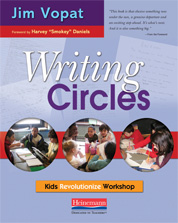
Jim Vopat reminds us in the introduction to his book of the long standing history and tradition of writing groups :


 Writers, sharing and talking about what they have written with other writers has likely been happening for as long as people have been writing. As Ann Ruggles Gere puts it in Writing Groups: History, Theory and Implications, " Writers have always asked friends and colleagues for feedback" (1987,22). For famous authors as well as kids reading stories they've written to each other,  there is something immensely satisfying in sharing writing and getting a response. ( p.3)

Vopat's book, Writing Circles: Kids Revolutionize Workshop provides a great foundation on which to build if you are interested in starting writing groups with kids. 

For additional support with writing groups for kids, I have always relied on the series of books by Ralph Fletcher, as both texts for my student writers, as well as sources of writing ideas.  Visit his web page to  learn more about this set of books.


For adult groups, there are many resources that are helpful.  I recommend my personal "writing teachers in my head": Natalie Goldberg, Georgia Heard and Bonnie Goldberg.  Their books will provide enough ideas  to keep a writing group going for years.  See my previous related postThe Writer's Notebook Part 2 (Resources) for a more complete list of recommendations of resources that will support your writing groups.


The writing prompts I use for writing groups of both kids and adults usually come from my own book, Deeper Writing: Quick Writes and Mentor Texts to Illuminate New Possibilities.  The ideas in this book can easily be adapted to fit your writing group's needs.


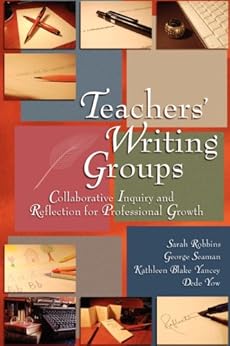
And finally, if you are interested in teacher inquiry writing groups,  Teachers' Writing Groups: Collaborative Inquiry and Reflection for Professional Growth by Sarah Robbins, George Seaman and Kathleen Blake -Yancey is an excellent resource.


 Today's Deeper Writing Possibilities

List  people that you might want to include in your own writing group.

What are the benefits in being a part of writing group?  What might be disadvantages that my hinder your writing?


Write about your expectations for  your writing group.  You may also want to create a list of rules to assist your group in running smoothly.  For example, there may be a limit on  the length of pieces shared or how often each member shares or how topics for writing are selected.