.jpg/120px-Montblanc_149_nibs_(DSC02303).jpg)
I write riding on the pens of those who came before me.
I teach writing looking over the shoulders and peeking into the minds of those who created new images of what writing instruction could look like.
 It was almost 30 years ago, that Jim Sims, the Language Arts Director for Columbus City Schools, handed me, along with my two colleagues and friends, Melissa Wilson and Marlene Beierele, copies of Writing: Teachers & Children at Work by
 Donald Graves, with directions to read it and see if we could use some of the ideas as we wrote the new elementary writing curriculum for our school system.
We each went home and dipped into this book; we each read the entire book in one sitting. We returned the next morning on fire-- exhilarated and brimming with new thinking. We did not write that day, but instead talked and processed, reacted and responded, sorted and discussed what we had read, the new ideas and principles we had encountered, and what they meant for the work we were doing.
 From Graves, we learned that children learn more about writing each time they write, if given the time to write. He taught us that children could write about people, places events, and feelings that were real--they could plumb their own lives for interesting, write-worthy topics. He challenged us to consider the interactions and contexts in which we were asking a child to write, what the child brought to the writing by way of skill and knowledge, and how we could teach what the child still needed in the context of her writing.
I know this all sounds familiar and routine in 2014, but in 1985, this was revolutionary.
And yes, much of Donald Graves' thinking went into the Writing Guide that was used in our district for more than a decade.
 A year later, our same team was asked to revise the newly minted guide. That year we were given The Art of Teaching Writing
 by Lucy Calkins. From her work we welcomed and incorporated the notion of mini-lessons. These short lessons provided necessary instructional scaffolding to foster better writing. They addressed the needs of the students as they arose--presenting, modeling, and guiding the use of all aspects of the writing process.
This was just the piece that was missing from our evolving thinking and our previous guide.
Now armed with new and revolutionary thinking that dramatically transformed how we thought about writing, and how we taught writing, the questions became How did this all fit in with the rest of our day? What does this really look like in the classroom?
Enter Regie Routman with Transitions, Invitations, and Conversations. Her books became staple texts in several literacy initiatiatives in our district. They showed us possible frameworks for teaching all of the language arts-- how to incorporate our new thinking into our teaching day with real students in real classrooms.


It seems that just when we were ready for more, the next needed idea would arrive, the next important principle would emerge.
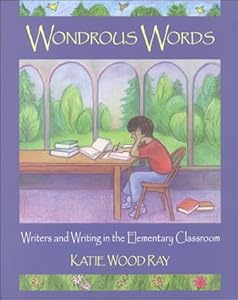 Katie Wood Ray's Wondrous Words: Writers and Writing in the Elementary Classroom
 was right on time.She taught us how to use mentor texts to learn how to write what we wanted to write. She affirmed that it is through reading that we are able to learn about writing, as we ask what words, structures, techniques and strategies a writer has used to achieve a desired effect. She helped us deconstruct texts-- noticing, identifying, and naming what authors have done-- and begin to use those same moves in our own writing, and more importantly, to help students use them in their writing, as well.
 And synthesizing all that we learned, Ralph Fletcher reminds us of the areas of expertise on which we draw to teach-- all that we know about language and writing, all that we know about the world, all that we know about our students and teaching. He reiterates the need for mentor authors and texts, and considers elements of craft. What a Writer Needs is what we needed to extend our own knowledge and confidence, and that of our writers.

 In more recent years, as I worked to help my students develop more sophistication and creativity in sentence construction, I turned to Don and Jenny Kilgallon and their sentence imitation models. Along with their resources and my own systematic instruction that I gradually developed with my students, we saw vast improvements in this area. There is at least one text for each level, with all of mentor sentences are excerpted directly from classic and contemporary literature. (My sentence work will probably be the focus of a future post.)
.

And finally, as we place greater emphasis on nonfiction, as we focus more on writing essays, research, and arguments, as well as the transition to college writing, the following resources have been essential. In fact, I reread Critical Passages: Teaching the Transition to College Composition periodically for the benefit of my personal writing.


I gratefully acknowledge my mentor teachers.
I appreciate their books that have led to transformation of writing for me, as well as the instruction I offer to my students
Today's Deeper Writing Possibilities
As a teacher, whose shoulder do you stand on as you teach? Which books have most influenced the way you teach writing, or your specific content area? What have you learned from your mentor teachers and texts?
If you are not a teacher, whose shoulders do you stand on in your chosen field? What books and resources have been essential in your growth and maturation?
Write a history, essay, or personal narrative detailing your evolution in writing life, teaching life, or professional life.


