Friday, April 5, 2013

THE RIGHTS OF CHILDREN


What did your childhood look like?

What words would define your experience?

The Articles of the Convention on the Rights of the Child, passed in 1989, provide us with a picture of an ideal childhood  by defining the rights of each and every child. 

The first 42 articles outline the rights, while the remaining articles (43-54) outline implementation strategies and measures. 

 The Rights of the Child were derived from the Universal Declaration of Human  Rights (UDHR), adopted by the United Nations in 1948,  to affirm that all human beings should be treated equally and with respect. Eleanor Roosevelt chaired the committee that wrote the UDHR. 

Many people felt there needed to be a separate and specific agreement to protect the rights of children and young people under the age of 18, particularly in countries where children are considered property.  The result was the Articles of the Convention on the Rights of the Child.

UNICEF has published a quick fact sheet summarizing each of the Rights of the Child.  


 The UNICEF website indicates that children have the right to the following:

  • a safe childhood
  • an early education
  • healthy living conditions
  • fair laws and practices
  • a voice that is heard/represented
After learning about these documents recently, both in a professional book and again at a session at a professional conference, I was shocked to discover that all nations belonging to the United Nations have ratified the Rights of the Child except two: Somalia and the United States. 

The United States has signed and adopted the agreement under Bill Clinton, but to date, not ratified the Rights.

Why?

Who would object to giving a child basic human rights?


Critics insists that by giving children the right to freedom of  thought and religion, as well as other rights,  the government usurps the power of parents to raise their children without interference. Parentsrights.org is one such organization.

President Obama  and his administration are urging that the U.S. join the 193 nations that have already ratified the  Rights of the Child.  

There are numerous websites on the Internet offering information in support of the Rights of the Child, along with petitions can be signed to urge ratification.  Change.org is just one.


There are also several books that help us initiate conversations with young people about both the Universal Declaration of Human Rights and the Rights of Children. (A quick search on the Internet will also result in many texts for adults, as well.)

The Universal Declaration of Human Rights
by Ruth Rocha and  Otavio Roth


For teachers who are interested in learning more or using the Rights of the the Child as a curriculum framework from which to  teach or foster inquiry projects  on social justice issues, A Critical Inquiry Framework for K-12 Teachers: Lessons and Resources from the U.N. Rights of the Child, edited by JoBeth Allen and Lois Alexander is an excellent  foundational resource.

Developed by  Red Clay Writing Project (NWP), this book illustrates how teachers engaged students in critical inquiry and discussion, as well as classroom and community projects,  around social  justice issues related to the Rights of the Child. Issues addressed include immigration,  racial  equality, poverty, rights to culture, identity and freedom of thought.

This book and its editors will be featured live in Using U.N. Rights of the Child as a Critical  Inquiry Framework on NWP Radio on April 11, 2013 at 7:00. The program will be archived and can also be accessed after the original air date by following the same link.

What do we want for our children?

What do we want for everybody's children?


Today's Deeper Writing Possibility


Make a list of words that describe an ideal childhood.  
List rights to which you think every child (or person) is entitled.
How closely does your list match the Articles of the Conventions on the Rights of the Child?

Search for more information on the Articles of the Conventions on the Rights of the Child.
You may want to start with the basic links above.

What is your opinion--should the U.S. ratify this agreement? Why or why not?

Write persuasive or argumentative essay outlining your opinion and including your evidence and support.

Write a letter to your senator urging the action that you recommend.


Wednesday, April 3, 2013

WHOSE STORY?


What is the truth?

Who tells your truth?

We all know the story of the Seven Blind Mice.  
They found an unusual something by the pond. Each variously went to investigate.
Each returned with a different conclusion about what it was.

A pillar. A snake. A spear. A great cliff. A fan. A rope.


When the  seventh mouse got to the something, she ran from one end to the other, up and down, to each side, and all around.  

She concluded that when all the parts discovered by each mouse  were considered together, the something could only be an elephant.

Our stories are like that sometimes.  We may each know a piece, a part, a sliver of the story.

Our version may not match the story of the same event told by our friend or spouse or other family member.

We tell stories based on the lenses we wear,  the individual perspectives from which we observe the world and experience our lives. (See related previous post Wrapping Our Words in a Container Lining.)

Perspectives can vary in many ways.  


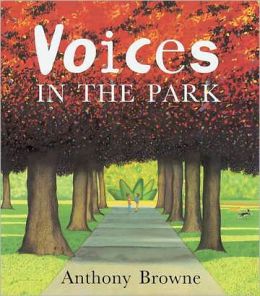
Voices in the Park by Anthony Browne allows us to have a look at how differently we each see people, places and situations.  This book allows us to see how our various perspectives encounter and confront each other, interact and negotiate meaning, and ultimately, determine how we act. 

Each individual voice in the text is given its own style, feel, and font.

Each individual sees the people and events in the park through distinct lenses.


How is your voice distinct from that of others? 

What font would represent your voice?

Our creative voices are just as distinct as our seeing, hearing, living voices.  We construct and represent our ideas to the world. 


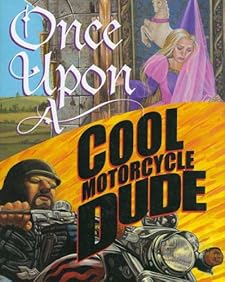
In Once Upon A Cool Motorcycle Dude by Kevin O'Malley, a boy and girl have to collaborate to tell  a fairy tale to their class.  

The results will delight all ages as the two wrestle with their very different perspectives of what should happen in a fairy tale and how it should be told. 

As their joint tale unfolds, speech bubbles allow us to peek at their thoughts and gain insight into their conflicting creative processes.  Again, changes in fonts illuminate different voices in the story.


As we think about perspectives, we  often delight in discovering the other side of the story, we usually want to know what other involved parties are thinking.

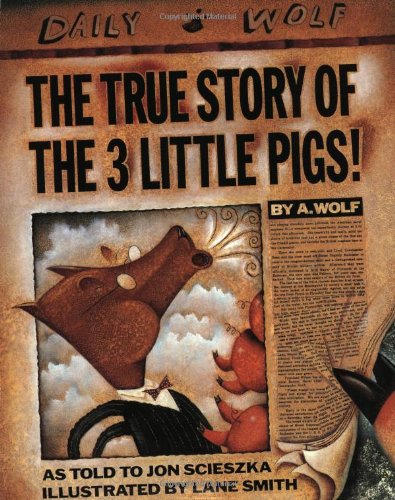
The True Story of the 3 Little Pigs! by A. Wolf as told to Jon Scieska gives us a humorous opportunity to think about the other side and to consider alternative motives and causes of actions in this familiar tale.


Who do you believe?  

How do you determine truth?


Sometimes it is our own perspectives that will differ depending on our continuing experiences and development.


In Marianthe's Story: Painted Words and Spoken Memories by Aliki we follow the growth  of Marianthe's  language, and power to give shape and words to her story, as she initially paints her story, gradually learns English, and finally, gains more confidence in her abilities to use this new language to tell her story. The text is comprised of  two distinct, yet related stories.  


How are our stories different if we use art, or music or some other sensory form other than words to tell it?

What are advantages of using these forms? What are advantages of using words?

In my classroom, one of my major goals in teaching Social Studies and current events, as well as just fostering our living together in community, was always to have as many voices as possible openly heard and critically examined.  This applied to the people and situations about which we read, as well as to ourselves.

There are many books that support that work and allow students to look at many sides.

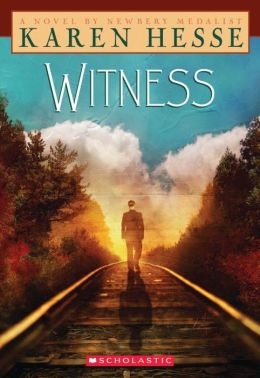
Witness by Karen Hesse and Bull Run by Paul Fleischman are two excellent examples of such texts.


In Witness, the citizens of a small Vermont town , tell their stories in poetry, as the Ku Klux Klan comes to their town in 1924. The characters include a young African American girl, a  young Jewish immigrant,  a bootlegger, a preacher, an unmarried farm woman.. and the list continues to include black and white, young and old, upstanding and criminal, those who support the Klan. those opposed, and those who are targeted.  Beliefs and reactions are shared by each in poems.

In Bull Run, the first battle of the Civil War is recounted in short prose pieces by 16 participants, from all walks of life--Northern and Southern, male and female, white and black, young and old. 

And finally, I always relied  on Phillip Hoose to provide my students with a child's perspective
no matter what period or events we were studying in history.  We Were There Too! Young People in U.S. History provides accounts of many children and teens that participated in our history.


Today's Deeper Writing Possibilities


Reflect on a recent event in your life or current events in  your community.

Write a short  poem or prose piece about this event.

Now think about other people who participated, witnessed, or were in some other way involved.

Write another short poem or prose piece from their perspective.
Try writing more pieces, so that you have several about the same event.

What did you discover by examining different  perspectives through your writing? 

Monday, April 1, 2013

POETRY: A PLACE TO STAND


We live our lives and in the living we learn and become.

Whether we make note of the learning,  whether we notice or not, as we journey on our path we are gathering extra bits of wisdom and knowledge .  

Whether we record the intuitive and passing observations or not, we come to know stuff—as we talk, as we read, as we interact and experience the world. 


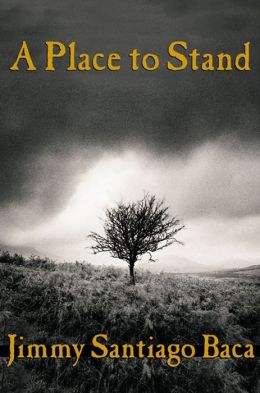
We come to know facts and understandings about the world, the creatures therein, and the phenomena  of our existence.  And ultimately, we come to know our place in  the world, or as Jimmy Santiago Baca experienced it and  named it, a place to stand.

In A Place to Stand, Baca declares:
...poetry helped make me the person I am today awakening creative elements that had long lain dormant in me, opening my mind to ideas, and enabling my intellect to nourish itself on alternative ways. Poetry enhanced my self-respect.  It provided me with a path for exploring possibilities for my life’s enrichments that I follow to this day   
Our current US poet laureate, Natasha Trethewey identifies just such a place to stand in the beginning of the title poem in Native Guard.  This collection is civil war poetry, which we may not often consider lyrical and poetic. 

In telling her mother’s story and her own, however, intertwined with the stories of the Deep South where the first black regiments, the Louisiana Native Guards, were called into service during the civil war, Trethewey achieves poetic and lyrical power.

Excerpts and more about the poem can be found  by clicking here.

What do we know? 
How do we know? 
How did we come to know? 

Many would tell us that poetry is the answer to all three questions. 

Poetry affords us a way to think about our life experiences, to process the events, the
relationships, and unknowns in our lives and in the world.  

Poetry can save us in uncertain times and poetry can light a fire in our lives and in our worlds that we cannot --dare not put out.

Naomi Shihab Nye expresses our need for poetry in speaking about poetry and 9/11 in the
introduction to 19 Varieties of Gazelle:
Writers, believers in words, could not give up words when the going got rough.  I found myself, as millions did, turning to poetry.  Why should it be any surprise that people find solace in the most intimate literary genre?  Poetry slows us down, cherishes small details. A large disaster erases those details.  We need poetry for nourishment and for noticing, for the way language and imagery reach comfortably into experience, holding and connecting it more successfully than any news channel we could name.
I  found  recent wars, with the numbers and statistics and the daily  routineness of the media 

reporting became quickly  both too big and unreal.  It  became real to me only through the small 

details and the personal experiences of my friend's son. The following excerpt  is from a longer

poem I wrote about and for her.


She ate her salad calmly
and we silently remembered
how many boys had died
in the last operation.
Operation with names
like Matador and Sword

She spoke of the operation Dagger
and how her child had to fire
a machine gun
for forty eight hours
to keep his life

We did not ask questions yet.
She ate her salad
and told us how her family
had watched the special
hosted by Oliver North
that followed the LIMA unit

She hesitated between bites
and told how at the end
they showed the standing rifles
capped with the helmets
of the dead boys.
Kneeling on one knee
beside the rifle and helmet
bare head bowed
in honor of his friend
was her son.

So we use the poetry-- we read poetry, we write poetry--to name our experiences, to measure and analyze, to record and remember, to inspire and raise up, to bring to awareness, and to sing out both our deepest sorrows and gladdest celebrations. 

And poetry has the power to make us change us, nourish us and show us new possibilities, new ways to live.
June Jordan attributes agentive powers to poetry:
And so poetry is not a shopping list, a casual disquisition on the colors of the sky, a soporific daydream, or bumper sticker sloganeering.  Poetry is a political action undertaken for the sake of information, the faith, the exorcism, the lyrical invention, that telling the truth makes possible.  Poetry means taking control of the language of your life.  Good poems can interdict a suicide, rescue a love affair, and build a revolution in which speaking and listening to somebody becomes the first and last purpose to every social encounter.  Why should power and language coalesce in poetry?  Because poetry is the medium for telling the truth, and because a poem is antithetical to lies/evasions and superficiality…
(Illuminations: Great Writers on Writing edited by Christina Davis and Christopher Edgar. )
And so we speak and listen to each other in poetry
And so we tell the truth with poems.  
And sometimes that truth surprises us.

Today's Deeper Writing Possiblity

 April is National Poetry Month.
Remember a time when poetry or words made you look at life, or a particular life’s event./situation/reality/relationship differently.
Are there uncertain times in which you turned to poetry—or poetry was given to you?
What are glad times when poetry was where you turned or was given to you?
Reflect on recent changes or possilibities you have been seeing, pondering or recently been introduced to in your life.

What is your truth? What truth are you coming to realize in your life?  What truth do you want to tell about your life?  

Write a poem :
  •  expressing your truth.
  •  about a time poetry saved you.
  •  about your place to stand.
  •  about what you have learned in  this life ( or a particular time in your life), how you know you know and how you came to know.
Write a poem or narrative or essay about change and new possibilities you see for your life.