Showing posts with label Common Core State Standards. Show all posts

Friday, October 18, 2013

MORE (OR LESS) IN THE CORE

Teachers are being asked to do more.

More...and more... and more...

Teachers I talk to regularly are overwhelmed.
Overwhelmed-- implementing the new Common Core Standards.
Overwhelmed--undergoing new teacher assessment procedures.
Overwhelmed--dealing with the increased required use of technology.

Teachers are frustrated and tired as they face many other new  requirements placed upon  them by their schools and districts.

They are drowning in demands that have doubled, tripled the number of laps they must swim just to finish their daily work.
Read two related posts: The Joy (and Burden) of Teaching and Teacher Vulnerability.

In addition to more responsibilities and demands put upon them by others, teachers are asking more of themselves.

Teachers are cramming more into lesson time frames--more than they believe their students should be asked to handle, more than they would have normally done--in the name of rigor.

Teachers are spending more time reading selected texts than they believe is necessary--more than their students actually need-- in the name of closer reading.

Teachers are assigning more written work-- more than they can effectively grade with appropriate feedback--in the name of challenge and preparation for college and the workplace.

MORE!

We have all seen those delightful AT&T commercials with the kids having discussions with a man about a variety of topics.  My favorite is the one in which the little girl explains why we should want more:
More is better than less...If you really like something, you'll want more of it.We want more.
We want more. Like, you really like it, ya want more...
Click here to watch this commercial.

More is not always better.
Sometimes less is just right.

In More by I.C. Springman, a magpie starts with nothing and little by little gathers more and more and more for her nest.  With the help of her mice friends--and as a result of a disastrous fall from the tree caused by way too much stuff-- she learns to achieve a  perfect balance of just enough.

I originally shared this lushly illustrated, sparsely worded picture book with our teacher inquiry group as some of our members were gathering more and more data-- it had almost become an addiction. This book reminded us that as some point we have enough.

I think this message applies just as well to  the "more" situations we encounter with implementing all the changes  this year. 

Sometimes, we can exponentially increase our results by intentionally starting small, beginning with less.

 That is the mathematical lesson we learn in One Grain Of Rice: A Mathematical Folktale by Demi.  In this traditional folktale, Rani is being rewarded for a good deed.  When offered a reward, she requests a meager one grain of rice---doubled every 30 days.  Do the math!  This very quickly becomes a monumental amount of rice and will feed her village for a long time.


More is not always better.
More can result from less than we sometimes think.
What is enough?
Enough is enough.

Who decides?

When I first read the common core,  I brought to the reading all of what I had heard and read prior to encountering the document myself.  I brought misconceptions, misinformation, and exaggerations.

The statement that gave me pause and great comfort-- the statement that we all need to hold onto-- as we navigate this new era of nationalized standardization is the following paragraph from the Introduction of the Common Core Standards which states clearly that this document is designed to outline results---not define the means in which we achieve these results:

By emphasizing required achievements, the standards leave room for teachers, curriculum developers, and states to determine how those goals should be reached and what additional topics should be addressed. Thus, the Standards do not mandate such things as a particular writing process or the full range of metacognitive strategies that students may need to monitor and direct their thinking and learning.  Teachers are thus free t o provide students with whatever tools and knowledge their professional judgment and experience identify as most helpful for meeting the goals set out in the Standards
(Common Core State Standards for English Language Arts, 4) 

So... do we need more?
We have to decide.
How much it too much?                                                                                                                            
What is enough.
Enough is enough.

Today's Deeper Writing Possibilities

What is overwhelming you?
In which areas are you being asked to do more?

Write a personal narrative or essay to express how you are feeling?
Who and what are helping you?  Who and what are hindering you?

Write a letter of advice to someone facing the same"more"  situations as you. In your letter include strategies you have found that help you navigate effectively through the "more."

Friday, July 12, 2013

THE JOY (AND BURDEN) OF TEACHING


Overheard...  everywhere:

Teachers make too much money.
Teachers have the whole summer off.
Teachers have it easy.

And the best one of all:

I could teach. It's not that hard.

Teaching is the one profession where most people think, given an opportunity, they could go into a classroom and do it.

Why?

Because everyone has been to school.
Everyone has had experience being in schools and "doing" school

These same folks would not dream of thinking they could do "doctoring" for a day, or do "piloting" with no training.

But everyone--our politicians, legislators, ministers, and neighbors--think they could successfully reform and run the schools, manage our classrooms, design our various curriculum, create dynamic lessons, and reach 100% achievement in all areas with all students.

The rising number of charter schools and schools in church basements started by  two ladies sitting in the last pew are evidence of this.

In reality, teachers-- good teachers, the ones you want your children to have, the ones most teachers I know strive to be-- spend at least part of their summer thinking about the coming year, preparing materials, reading the latest professional books or potential new books for their students, meeting and planning with colleagues, as well as attending classes, seminars and conferences.

They are also out spending their own money-- lots of it-- to buy books and other supplies for their classrooms and their students.

And they are doing all of this under an ever-growing weight of testing and assessments, teacher evaluations heavily weighted on the same,  new federal and state legislation, expanding curriculum, and increased diversity of needs in their students. 


In Success Stories From a Failing School: Teachers Living Under the Shadow of NCLB (PB)  by Marilyn Johnston-Parsons and Melissa Wilson, teachers at an urban school share poignant stories of the successes they were able to accomplish, as well as the hindrances of the enormous amount of testing and other artificial activities centered around NCLB "accountability." 

When this book was first published, many of the essays, letters, dialogues and other pieces were performed locally by these teachers. What a powerful image this presented of life for both students and teachers under No Child Left Behind !


We do not realize the mounting responsibilities of teachers--it has grown steadily since the beginning of the last century.  Jamie Vollmer gives us a glimpse of the expansion of curriculum and required duties--decade by decade-- in The Ever Increasing Burden on America's Public Schools.

Many people, groups.... and  books suggest answers for our schools.
Some suggest that just changing one thing will make a huge difference. 

 In Once Upon an Ordinary School Day by Colin McNaughton,  it is the arrival of an extraordinary substitute who played music and invited  the children to draw and write to the music that made all the difference--turning an ordinary school day and  an ordinary school into something extraordinary.

Is there really some one miraculous thing that will do it? 


Some folks think we that more time--added to the day, the week, the school year-- is the answer.  They think more of whatever we are doing will do the trick.

In A Fine, Fine School by Sharon Creech, the principal gets caught in this trap.  His school is great and he erroneously thinks more "school" will produce an even finer school.  Of course, this plan backfired and everyone concluded that what made their school fine in the first place was the best path.


And then there are proponents of creative schools that foster inquiry and discussion and collaboration and authentic thinking and learning --which is also fun for both the students and the teachers.

Hooray for Diffendoofer Day! by Dr. Seuss, with Jack Prelutsky and Lane Smith, tells about just such a school.  And... because the kids in this school did learn both to think and how to learn... they did great on the test!

We all want our schools to be wonderful.  
Teachers I know work hard to make this happen every day.
They spend their time and their efforts to make this happen for each and every student they touch.

Both  Mr. Falker and Mr. Lincoln, characters in two books by Patricia Polacco, are that kind of educator, the kind we may have been blessed to have in our lives, the kind we pray for in our own childrens' lives... and the kind we teachers want to be when we grow up.

 
We all want our schools to be wonderful.  
And I repeat, the teachers I know work hard to make this happen every day.
They spend their time and their efforts and their money to make this happen for each and every student.

These teacher are classics.

They don't make too much money.
They don't have it easy
They don't spend their summer doing nothing.

And just anybody CAN NOT walk in their shoes and do what they do.


Today's Deeper Writing Possibilities

What changes would you like to see in our schools and public education?
What is the best way to accomplish the changes  you desire?
Write a letter to the editor or draw up a petition to initiate your suggestions.

Write a poem, narrative or essay about your experiences in school--positive or negative.
You may remember a special teacher, or a particular day that made all the difference for you.


Monday, May 13, 2013

COMMON CORE EXPLORATIONS- PART 2

The Common Core State Standards.  

What do you think about them?

As part of a Teacher Inquiry Group which I co-facilitated in 2011 and 2012, we delved into the mysteries of the Common Core State Standards (CCSS), critically examining the document itself, as well as several other documents, videos, and resources.

The details of our exploration of the CCSS, as well as the resources that we found helpful or thought-provoking are outlined in the previous post, Common Core Explorations-Part 1.

As preparation for our group session on the CCSS, we each wrote an individual response to the following prompt:
Respond to the CCSS in terms of your overall feelings about the entire document as well as your response to the levels with which you are most familiar. What strikes you as a dominant characteristic? What are you pleased to see? What surprises you about the Core Standards? What is missing? What is there that you feel shouldn’t be?
My  initial response (written in December 2011) is below:


The Common Core State Standards (CCSS) read in one sitting are daunting and overwhelming just by the sheer volume of detail included.   

It is immediately obvious that informational texts in reading and writing have taken center stage in this document, although, despite what I keep hearing, there is still a place for narrative, and also a balance between the two types of texts through middle school.  

 By grade 12, however, the field is skewed----- 70% informational and 30% literary texts in reading, and 80% informational texts (persuasive and explanatory) in writing and 20% only to convey experiences.

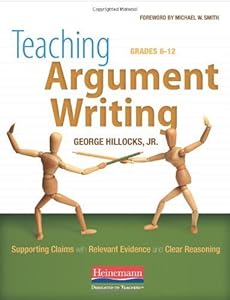
At the time I  set out to read the Common Core Standards, I was also reading Teaching Argument Writing by George Hillocks, who makes a distinction between persuasive writing and argumentation. He defines persuasive writing as having a single purpose—that of convincing--- it is demonstrated in propaganda and advertising.  Persuasive writing often
appeals to emotions, using the most favorable evidence, and also style to convince.

According to Hillocks, on the other hand: 
...argument is mainly about logical appeals and involves claims, evidence, warrants, backing and rebuttals... (He sees).. argument at the heart of critical thinking and academic discourse.(xvii)
As I read his explanations I don’t quite see this logical aspect included in the CCSS, although the language of evidence, claims, and such is used.  Reasons (language that is also used ) are not always evidence and don’t have to be proven logically.  

Are we confusing students? Or am I confused?

I am pleased to see recognition of the fact that all teachers need to be teaching both reading and writing.  I am also pleased to see that disciplinary-specific reading and writing is called for, acknowledging that there are specialized vocabularies, structures, and genres associated with specific disciplines.

The statement that gives me comfort and that I intend to hold onto as we enter this new era of nationalized standardization is the following, which states clearly that this document is designed to outline results---not define the means in which we achieve these results:

By emphasizing required achievements, the standards leave room for teachers, curriculum developers, and states to determine how those goals should be reached and what additional topics should be addressed. Thus, the Standards do not mandate such things as a particular writing process or the full range of metacognitive strategies that students may need to monitor and direct their thinking and learning.  Teachers are thus free to provide students with whatever tools and knowledge their professional judgment and experience identify as most helpful for meeting the goals set out in the Standards (CCSS -page 4)


Disappointingly,  the CCSS do not at all deal with realities we face daily:  the needs for intervention,  and acceleration, support for English language learners or students with other  special needs, and those additional readiness elements not defined by simple reading, writing, speaking and listening goals. 

 I believe those “other readiness goals”  are described in the Framework for Post Secondary Writing as Habits of Mind that we want students to have no matter what they are learning, reading or writing.  

This document indicates that the way we achieve the Habits is by writing, reading and thinking critically and, as an aside, the word thinking seems glaringly absent from the CCSS--or was that just my own perception?

Curious about the suggested exemplar texts, I perused Appendix B. There does seem to be wide range of texts in each of three categories--- stories (which includes novels and short fiction), informational texts, and poetry).   The texts selected seem to be a combination of classic texts that we have all used over the years, as well as newer texts--particularly in the information categories. 

At my most recently familiar level the novels seem a bit hard for the average student—they are the ones we would have read aloud—only some students would have been able to read these independently. 

Read-aloud selections are indicated as well for each category of texts, through grades 2-3—this feature drops out at the levels above this.  I believe this is unfortunate-- I believe reading aloud has its place at all levels. Part of reading is hearing texts, hearing the language and structures and word choices.

Performance tasks are included at each level for each category of text.
For most texts a snippet of is given to show the level and complexity of the text.

My questions after this initial digging into the Core:

  • How will this  be implemented?
  • How scripted will the curriculum guides be? 
  • Will administrators take the suggested lists as requirements and make these texts mandatory whether appropriate or not?. 
  • Will subject matter in the content areas remain the same with the new reading and writing goals overlayed?

Will teachers have input into what all of this looks like?

Will it last? 

Or will it be gone like like other standards and assessments-- the dead proficiency test replaced by the OAA and the OGT  (all Ohio assessments), with the latter now being replaced by the SAT and exit examines?

Will it last?


Today's Deeper Writing Possibilities


After reading the Common Core State Standards, what are you thinking?
What are your questions?

Write a reflection on how the CCSS will affect your teaching, your classroom and students and your community.